

The costly question behind every print run
A print decision often begins with a forecast: how many copies will readers buy, how quickly will booksellers reorder, and how much stock should be ready on launch day? Get the estimate wrong and the consequences travel through the whole publishing business. Too many copies tie up working capital, warehouse space and handling time.
For years, publishers have managed this tension by balancing offset printing, which is efficient at larger volumes, against digital printing and print-on-demand (POD), which make smaller quantities more practical. The strategic opportunity is not to replace one method with another.
Table of Contents
The direction is visible in industry research. A 2025 production-digital-printing report, drawing on NAPCO Research, found that buyers of book-printing services associated digital printing with lower unit costs, upfront inventory costs, shipping costs and warehousing costs [1].
Know the three production models
Offset printing remains useful when a title has predictable demand and a large enough print run to spread setup costs across many copies. It can deliver attractive unit economics, consistent quality and a wide range of paper and finishing options. Its weakness is not the technology itself; it is the risk of committing to a volume that takes longer than expected to sell.
Short-run digital printing sits between offset and POD. A publisher can order a limited batch—perhaps enough for a campaign, a seasonal period or a known institutional order—without commissioning a large run. It can be useful when demand is real but uneven, when a title needs a quick replenishment, or when a publisher wants to test a revised edition before scaling up.
POD prints a copy when an order is received. It can keep a long-tail title available without maintaining a warehouse stockpile. That is especially useful for specialist monographs, backlist titles, low-volume academic books and books with sporadic international demand.
The right answer is a portfolio, not a rule
A publisher should segment its catalogue using demand velocity, forecast confidence, title lifecycle, format and contribution margin. A high-profile new release with reliable retailer commitments may justify offset printing. A mid-list title with a seasonal spike may fit short-run digital. A specialist backlist title selling a few copies each month may be a strong POD candidate.
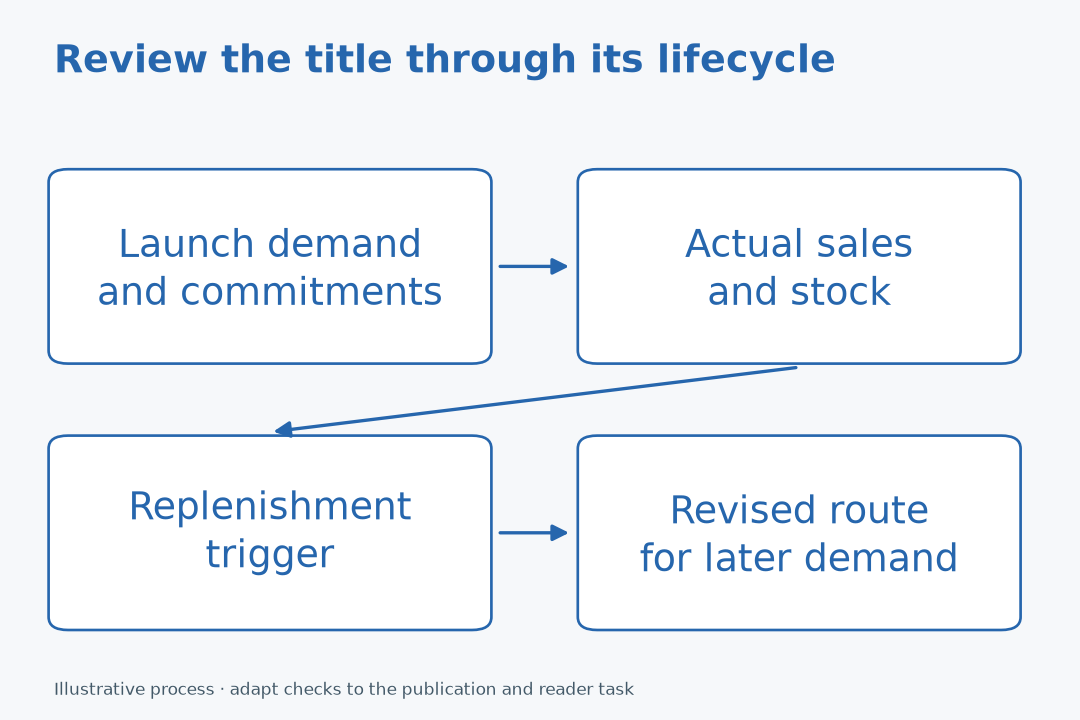
This lifecycle view prevents a common mistake: treating the print method as a permanent decision. Revisit the choice when sales patterns change, a new edition is released, a major review or award creates a spike, or a rights deal opens a new market.
The economics must be compared at the total-cost level. Include unit printing cost, setup charges, freight, storage, pick-and-pack, returns, destruction or pulping, cash tied up in inventory, and the cost of stockouts. POD may have a higher manufacturing cost per copy but a lower total cost for low-volume titles. Offset may be cheaper per unit but expensive when many copies remain unsold.
Returns, availability and the terms that matter
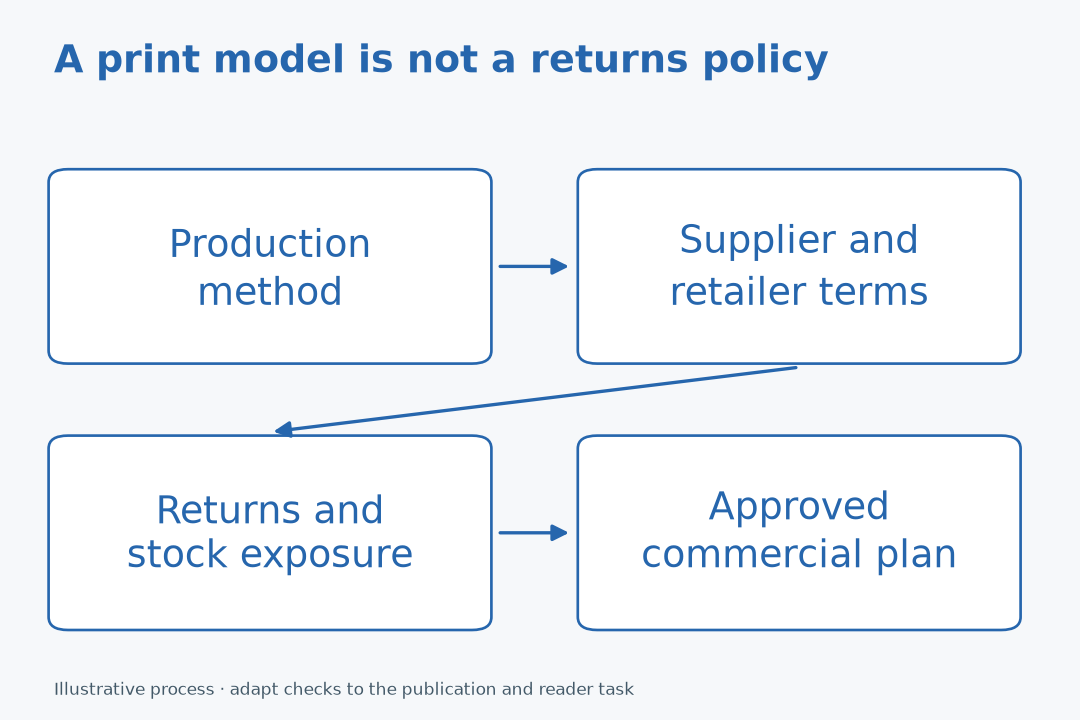
Returns policies can change the financial result. In some trade channels, booksellers may return unsold copies under agreed terms. Publishers should model the cash impact of returns, not just the initial shipment. POD does not automatically eliminate return exposure: distributors and retailers may have different eligibility rules, fees and timelines.
Availability also depends on reliable metadata and file readiness. A POD workflow is only fast when the printer has a validated interior PDF, cover file, trim size, paper specification, ISBN and accurate product data. A missing or outdated file can delay fulfilment just as effectively as an empty warehouse.
Service-level expectations matter. A retailer may place a large order after a title receives publicity or enters a course reading list. A POD provider optimized for one or two copies may not be able to deliver several thousand copies quickly at the same cost.
Build a demand-led print decision
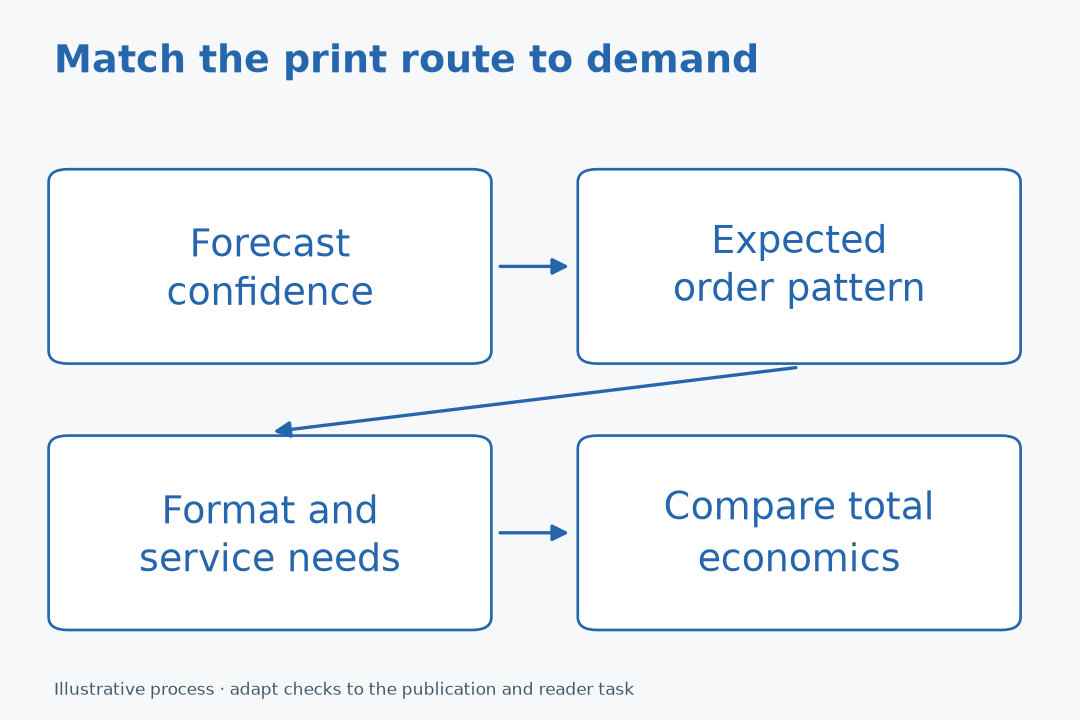
A practical decision process can begin with two signals. First, calculate recent sales velocity by channel and geography; do not rely solely on the first print run forecast. Second, estimate forecast confidence by separating firm orders, historical baseline sales, promotional expectations and speculative demand.
Use these signals to create production bands. High-confidence, high-volume demand can go to offset. Medium-volume or variable demand can be managed through short-run digital batches. Low-volume, long-tail demand can move to POD. Define triggers for changing bands—for example, when a title’s rolling sales average reaches a threshold, when stock cover falls below a target, or when a confirmed bulk order arrives.
Forecasting should remain a human-supported process. Sales history can be combined with retailer preorders, course-adoption data, seasonal patterns, marketing calendars, rights sales and comparable titles. Yet a model cannot know every event: a viral mention, a supply-chain disruption or an unexpected institutional purchase can change demand overnight.
A practical scenario: a specialist backlist
Imagine an academic publisher with a backlist of 600 specialist titles. A handful of high-demand textbooks sell steadily and are printed in larger quantities. Many monographs, however, sell only a few dozen copies a year. The publisher currently reprints those titles in batches of 500 because that is the historic procurement habit.
The publisher classifies the catalogue by sales velocity and title risk. It keeps offset printing for predictable textbooks, uses short-run digital batches for titles with known adoption periods, and shifts most low-volume monographs to POD. It also identifies ten titles with a likely near-term course adoption and arranges a short-run buffer with the printer.
After six months, the team compares not only print spend but also stock value, warehouse handling, returns, fulfilment time, stockouts and lost orders. The scenario is illustrative, not a claimed case study.
A phased way to make the change
Begin with a catalogue audit. Identify titles with slow stock movement, frequent reprints of small quantities, high return exposure, obsolete inventory or repeated stockouts. For each, calculate the full cost of holding and replenishing stock. Include the costs borne by distribution partners where they flow back to the publisher through fees or returns.
Next, run a controlled pilot across different title types: one long-tail monograph, one steady mid-list title and one title with seasonal demand. Compare POD and short-run quotes with current offset economics. Check physical quality, supplier lead times, print-file requirements, retailer ordering, returns terms and international fulfilment. Set a service target so a lower inventory figure does not hide a decline in reader availability.
Finally, build a regular review into editorial and operations planning. Sales, production, warehouse, finance, rights and marketing teams should share the same title-level view. The goal is not zero inventory at any cost. It is to hold the inventory that earns its place, replenish efficiently, and keep lower-volume works discoverable and purchasable without repeatedly betting on demand that may never arrive.
The strategic takeaway
Print-on-demand and short-run digital printing give publishers more options, but the advantage comes from matching the method to the book—not from adopting a fashionable technology. A hybrid model can protect the economics of high-volume titles while extending the life of specialist and backlist works.
Frequently Asked Questions
What is the difference between short-run printing and print-on-demand?
Short-run printing produces a small batch in advance. Print-on-demand generally produces each copy in response to an order, reducing the need to hold finished stock.
Is print-on-demand always cheaper?
No. The unit cost can be higher. POD may still lower total cost for low-volume titles because it reduces storage, overproduction and inventory exposure.
Which books are best suited to POD?
Specialist, academic, backlist, low-demand and out-of-print titles are often good candidates, provided quality, price and fulfilment times meet reader expectations.
Should a publisher stop using offset printing?
Not necessarily. Offset can remain the most economical choice for high, predictable volumes or jobs with demanding colour and finishing requirements.
Does POD eliminate book returns?
No. Returns depend on retailer, distributor and printer terms. Publishers should confirm returnability, fees and credit rules before switching a title.
How can publishers handle an unexpected sales spike?
Agree capacity and escalation plans with printers, maintain print-ready files, identify alternative short-run capacity, and define when a larger offset run becomes economical.
Related reading: Explore more publishing technology articles.